Articles
The following list contains all of the articles that Farmer has written that I have been able to collect any information on. I have listed the title, where the article was published and a description if I have read it.
Bradley Brave Sees New York With Observing Injun Eyes --- And with Knocking Knees
Here is a newspaper article Phil wrote for his college school newspaper after his trip to New York to present Fred Warring with a headdress on his radio program, to thank him for writing the school's fight song. You can see three more pictures about this event on the Photo Gallery page (the third, fourth and fifth pictures from the top).
- The Bradley Tech, October 31, 1940 (First appearance)
- THE PHILIP JOSÉ FARMER CENTENNIAL COLLECTION, Meteor House, 2018 Deluxe Limited Edition hardcover, hardcover, trade paperback

Lovers and Otherwise
A very interesting article by Farmer about writing The Lovers and trying to get it published.
- Fantastic Worlds, Spring 1953 (First appearance)
- PEARLS FROM PEORIA, Subterranean Press, 2006 hardcover
- THE PHILIP JOSÉ FARMER CENTENNIAL COLLECTION, Meteor House, 2018 Deluxe Limited Edition hardcover, hardcover, trade paperback

The Tin Woodman Slams the Door
An essay by Farmer describing how much the world of Oz meant to him as child. As he grew up however, the stories began to lose their magic as compared to some of the other worlds he had been introduced to. Later on he rediscovered Oz and a greater appreciation for its magic. That's my boring version of it, Farmer's way of putting it is much, much, better.
- Destiny, Summer 1954 (First appearance)
- Oz Story 6, 2000
- PEARLS FROM PEORIA, Subterranean Press, 2006 hardcover
- THE PHILIP JOSÉ FARMER CENTENNIAL COLLECTION, Meteor House, 2018 Deluxe Limited Edition hardcover, hardcover, trade paperback


White Whales Raintrees Flying Saucers
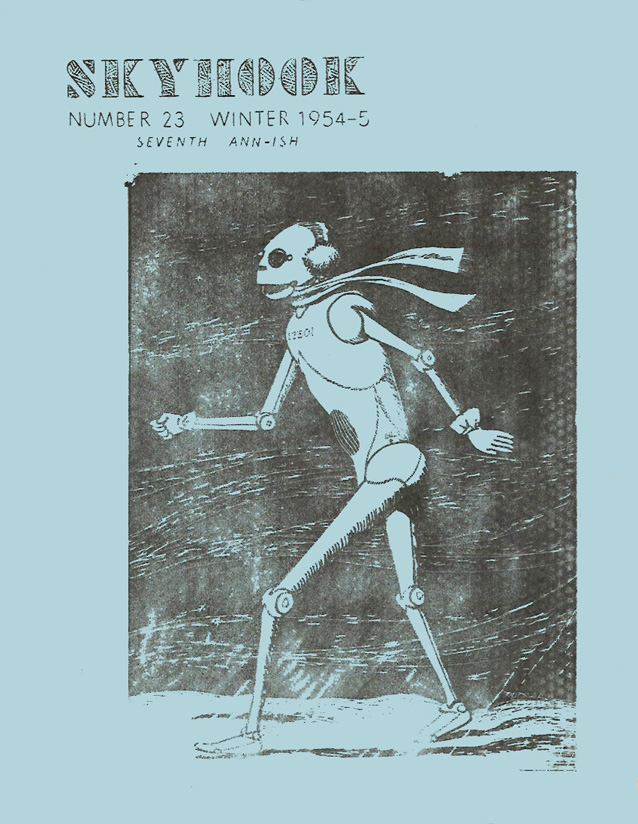
An interesting editorial, where Farmer gives his definition of good fictionand illustrates how science-fantasy can meet these standards. In the much longer Skyhook version of the article, Phil first goes off on a tangent discussing good and evil. He then gives many examples of science fiction writers capable of writing literature, and conversely many great literary writers who have written science fiction or fantasy, although the mainstream critics do not consider it to be so.
- Fantastic Universe, July 1954 (First appearance)
- Skyhook 23, Winter 1954-1955 (revised and expanded)
- Original version also appeared in: PEARLS FROM PEORIA, Subterranean Press, 2006 hardcover
- Expanded version also appeared in: Farmerphile 11, January 2008


The Golden Age and the Brass
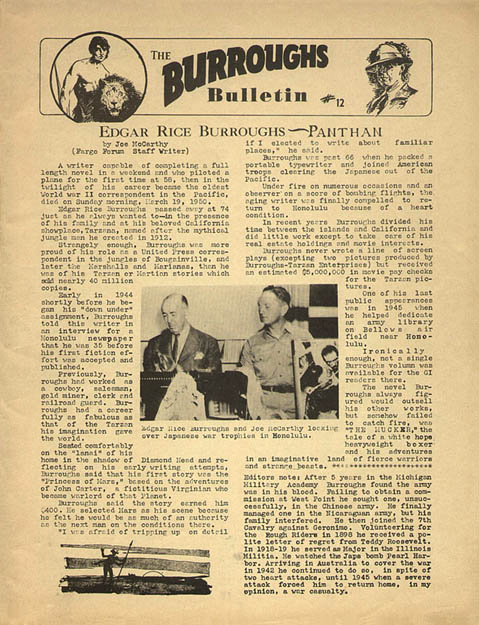
An article by Farmer where he discusses his early reading and his mythological heroes who were all put in the dust when he discovered Edgar Rice Burroughs. This was his Golden Age. He then laments that his son, ignoring his father's collection of fantastic reading, is only interested in comic books. What Farmer calls Brass as compared to his Gold.
- Burroughs Bulletin, #12, 1956 (First appearance)
- BURROUGHS BULLETIN OMNIBUS EDITION OF #1-12 (1947-1956), 2005
- PEARLS FROM PEORIA, Subterranean Press, 2006 hardcover
Entry in Who Killed Science Fiction?
In 1960 Earl Kemp sent out a questionnaire to 108 people in science fiction. 71 replied to these five questions under the heading "Who Killed Science Fiction?"; 1) Do you feel that magazine science fiction is dead? 2) Do you feel that any single person, action, incident, etc., is responsible for the present situation? 3) What can we do to correct it? 4) Should we look to the original paperback as a point of salvation? 5) What additional remarks, pertinent to the study, would you like to contribute? This appeared in his fanzine, Safari, and went on to win the 1961 Hugo award for best fanzine.
- The First Safari Annual, April 15, 1960 (First appearance)
- eI , Vol. 5 No. 6, December, 2006 (click on the link to read it online)

On a Mountain Upside Down
A tale from Farmer about his experiences mountain climbing in Arizona. When he reached the top of a mountain he did a hand-stand to get a different perspective of the surrounding scenery.
- JD Argassy (front) (back), #55, 1960 (First appearance)
- PEARLS FROM PEORIA, Subterranean Press, 2006 hardcover
- THE PHILIP JOSÉ FARMER CENTENNIAL COLLECTION, Meteor House, 2018 Deluxe Limited Edition hardcover, hardcover, trade paperback


Blueprint for Free Beer
An article about Farmer's economy of abundance.
- Knight, July 1967 (First appearance)

Reap (Baycon Guest-of-Honor speech)
This is Farmer's famous (or infamous) speech which was given at Baycon in 1968. He talked about science fiction's failure as an "early warning" system to today's problems. He also talked about the Triple Revolution Document.
- Science Fiction Review #28, November 1968 (First appearance)
- Mimeographed limited edition for the Science Fiction Writers of America, 1968

Oft Have I Travelled (on Solar Pons)
Solar Pons is a Sherlock Holmes type character, created by August Derleth. In this brief essay Farmer compares Pons to Holmes and Derleth to Doyle and wishes that Derleth would continue to write about Pons.
- The Pontine Dossier, April 1969 (First appearance)
- PEARLS FROM PEORIA, Subterranean Press, 2006 hardcover
- Reprinted in: The Solar Pons Gazette Vol 1.1, Summer 2006

Answers to Questionaire
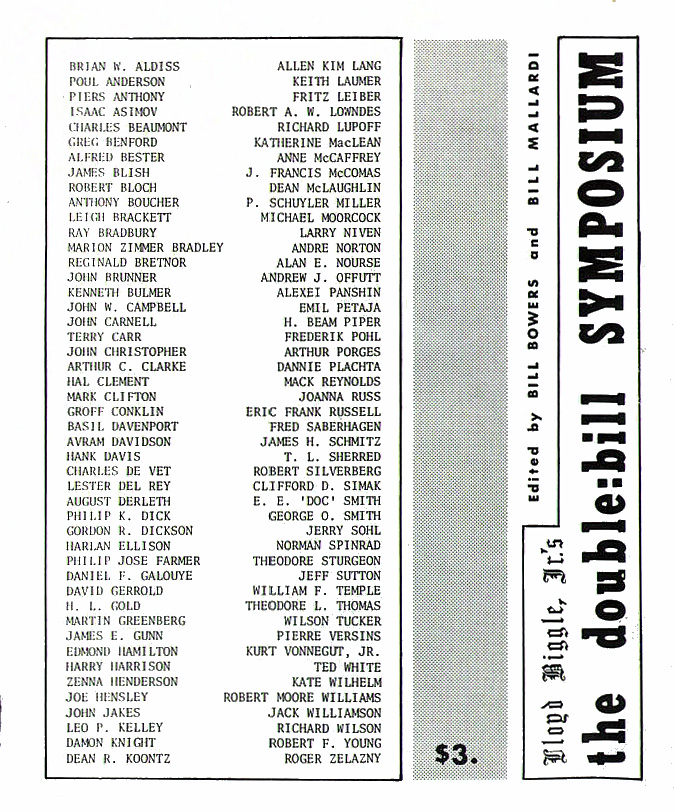
The original answers to this questionaire by 72 science fiction authors and editors were printed in three issues of the fanzine Double:Bill; #7 (October 1963), #8 (January 1964) and #9 (June 1964). In 1969 when they decided to collect all the answers in one book, they sent the questionaire out again and were able to add another 22 for a total of 94 respondents. Phil Farmer is in this group of 1969 authors so his answers do not appear in any of the three fanzines. The questionaire contained eleven questions about writing science fiction. Most authors answered eight or nine questions, Phil answered all eleven.
- Double:Bill Symposium, August 1969 (First appearance)
Report
Farmer wrote a report on the Second International Film Festival, Rio de Janeiro, March 23-31, 1969. The article begins as Phil and and fellow scifi authors; Alfred Bester, Arthur C. Clarke, Harlan Ellison, Harry Harrison, Sam Moskowitz, and A. E. von Vogt, are getting on the plane to come home. Most of the report, which he calls a travelog of the mind, takes place on the plane ride home.
- Luna 6, 1969
- Also appeared as The Josés from Rio in: PEARLS FROM PEORIA, Subterranean Press, 2006 hardcover (First appearance)
- Also appeared as The Josés from Rio in: THE PHILIP JOSÉ FARMER CENTENNIAL COLLECTION, Meteor House, 2018 Deluxe Limited Edition hardcover, hardcover, trade paperback

The Affair of the Logical Lunatics
Farmer discusses the state of the world and what affect science fiction can have on the future.
- Speech at Bradley University, May 1971
- Transcription appears in: Farmerage Volume 3

The Arms of Tarzan READ IT HERE
Farmer goes to great pains to explain the items that he placed on the coat of arms.
- Burroughs Bulletin #22, 1971 (First appearance)
- MYTHS FOR THE MODERN AGE, 2005
- PEARLS FROM PEORIA, Subterranean Press, 2006 hardcover
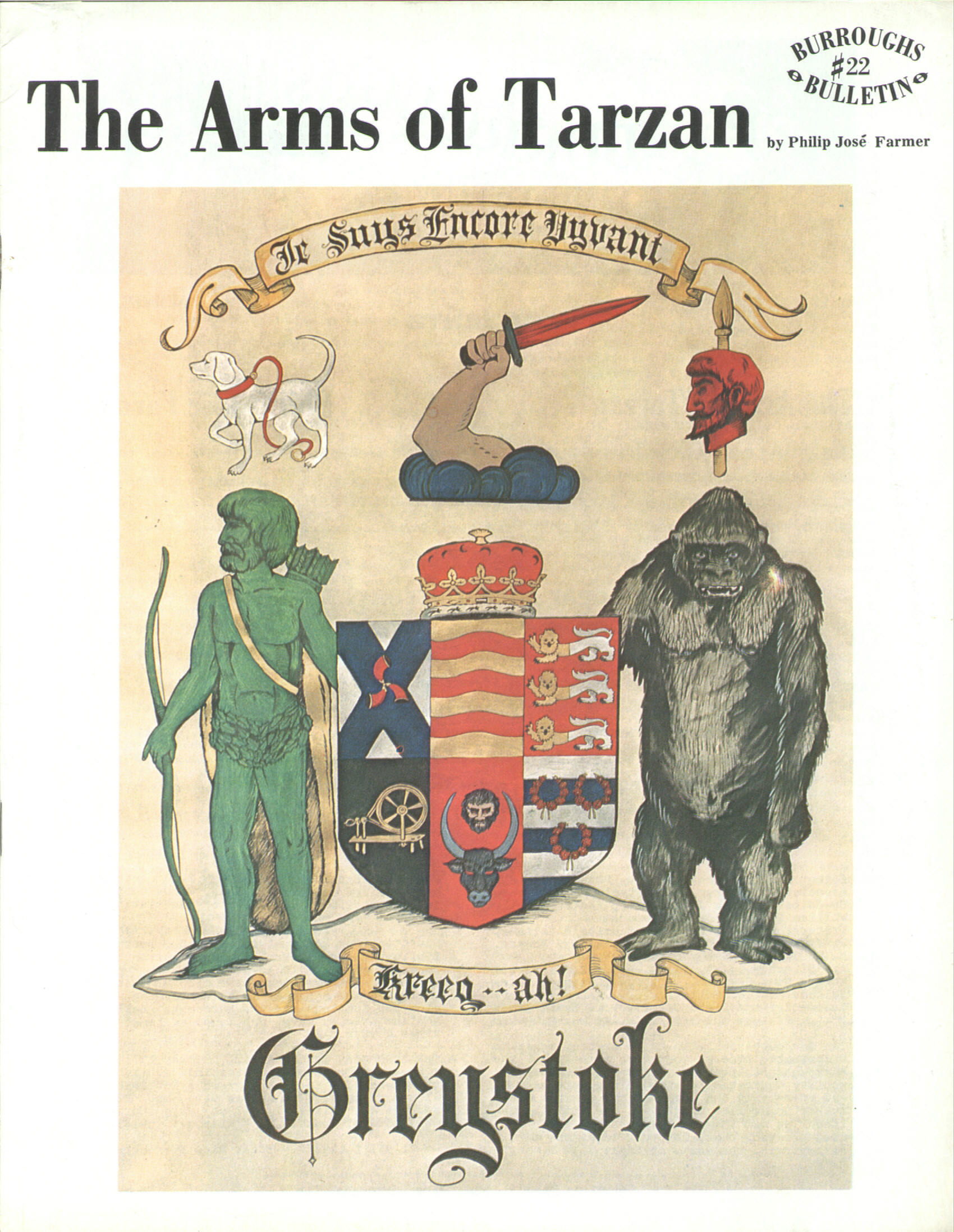
Tarzan's Coat of Arms
A longtime Tarzan fan, Farmer designed the Greystoke coat of arms. This also appears in Tarzan Alive.
- ERB-Dom 52, November 1971 (First appearance)

The Two Lord Ruftons READ IT HERE
Farmer has fun linking a Lord Rufton from a Sherlock Holmes story (The Disappearance of Lady Frances Carfax), and a Lord Rufton written about by the famous Napleonic soldier Brigadier Étienne Gerard.
- The Baker Street Journal, December 1971 (First appearance)
- MYTHS FOR THE MODERN AGE, 2005
- PEARLS FROM PEORIA, Subterranean Press, 2006 hardcover

The Obscure Life and Hard Times of Kilgore Trout
One of Farmer's first biographies of a fictional person. He of course took it a step further and later wrote a book by Trout.
- Moebius Trip 11, December 1971 (First appearance)
- An expanded version also appeared in: THE BOOK OF PHILIP JOSÉ FARMER , 1973
- VENUS ON THE HALF-SHELL AND OTHERS, Subterranean Press, 2008 hardcover


A Reply to "The Red Herring" READ IT HERE
Farmer discusses and article that appeared in issue #27 about discrepancies in Tarzan's and Korak's age. He refers to his biography of Tarzan which is coming out in April but gives the title as THE PRIVATE LIFE OF TARZAN.
- Erbania #28, December 1971 (First appearance)
- MYTHS FOR THE MODERN AGE, 2005
- PEARLS FROM PEORIA, Subterranean Press, 2006 hardcover

Tarzan Lives
Farmer gets a brief interview with John Clayton.
- Esquire, April 1972 (First appearance)
- THE BOOK OF PHILIP JOSÉ FARMER , 1973 as "An Exclusive Interview with Lord Greystoke"
- TARZAN ALIVE, Bison Books, 2006 trade paperback
- THE PHILIP JOSÉ FARMER CENTENNIAL COLLECTION, Meteor House, 2018 Deluxe Limited Edition hardcover, hardcover, trade paperback

The Great Korak-Time Discrepancy READ IT HERE
The book SON OF TARZAN has sparked much debate among ERB fans. Without going into great detail the problem is that the dates in "Son" don't line up with the rest of the Tarzan novels. At the end of The Beasts of Tarzan, Jane is breast feeding their son, when "Son" came out 2 years later he was much too old. Farmer's theory is that Korak is actually Tarzan's nephew and since ERB wrote about him as Tarzan's son, he could not write about Tarzan's real son's exploits later. It's all rather complicated. Farmer also has some comments about his interview with Lord Greystoke that just appeared in Esquire magazine.
- ERB-Dom 57, April 1972 (First appearance)
- MYTHS FOR THE MODERN AGE, 2005
- PEARLS FROM PEORIA, Subterranean Press, 2006 hardcover

The Lord Mountford Mystery READ IT HERE
Farmer writes about where the world of Tarzan and the world of Allan Quatermain intersect. The parents of ERB's Lord Mountford appear in the 1917 Quatermain novel, FINISHED.
- ERB-Dom 65, December 1972 (First appearance)
- MYTHS FOR THE MODERN AGE, 2005
- PEARLS FROM PEORIA, Subterranean Press, 2006 hardcover

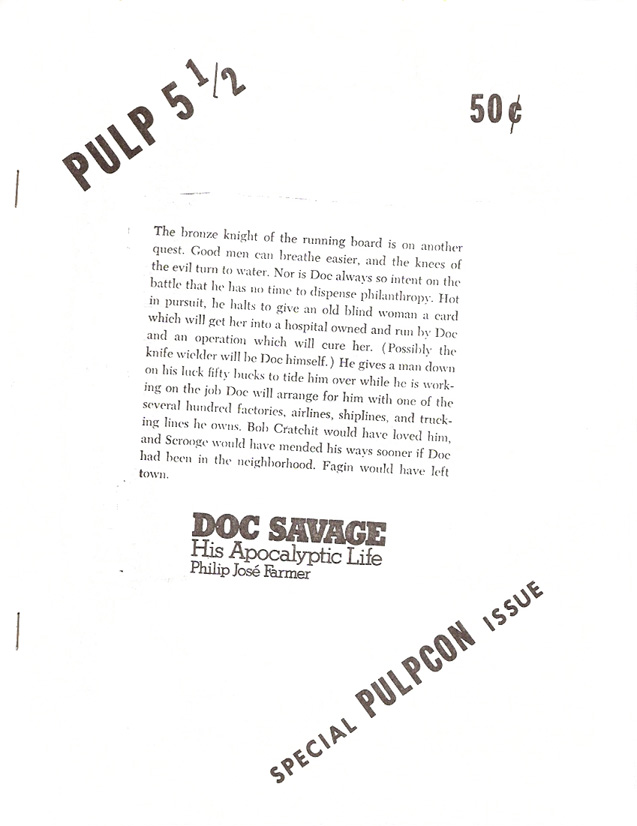
Writing the Biography of Doc Savage
Farmer talks about writing DOC SAVAGE: HIS APOCALYPTIC LIFE and dealing with publishers.
- Pulp #5 1/2, July 1973
- THE MAN BEHIND DOC SAVAGE, as Writing Doc's Biography, 1974 (First appearance)
- PEARLS FROM PEORIA, Subterranean Press, 2006 hardcover
- THE PHILIP JOSÉ FARMER CENTENNIAL COLLECTION, Meteor House, 2018 Deluxe Limited Edition hardcover, hardcover, trade paperback

From Erb to Ygg READ IT HERE
Farmer traces Edgar Rice Burroughs geneology all the way back to the Norse god Ygg. Just how far back he should be taken seriously is hard to say.
- Erbivore, August 1973 (First appearance)
- MYTHS FOR THE MODERN AGE, 2005
- PEARLS FROM PEORIA, Subterranean Press, 2006 hardcover

To the Wizard of Sci-Fi
Forrest J Ackerman was the guest of honor and the convention program contained tributes about Forry from several authors. Farmer's tribute talked about (and reprinted) a letter a young Forry wrote to Amazing Stories in 1932 and about the fact that he has an actual yellow brick road in his backyard.
- Lunacon '74 Covention Program Book, April 1974 (First appearance)
- PEARLS FROM PEORIA, Subterranean Press, 2006 hardcover
- THE PHILIP JOSÉ FARMER CENTENNIAL COLLECTION, Meteor House, 2018 Deluxe Limited Edition hardcover, hardcover, trade paperback

Extracts from the Memoirs of "Lord Greystoke"
After Farmer interviewed Lord Greystoke, Greystoke promised him he would send him some portions of his memoirs which he could publish.
- MOTHER WAS A LOVELY BEAST, 1974 (First appearance)
- TARZAN ALIVE, Bison Books, 2006 trade paperback
- UP THE BRIGHT RIVER, Subterranean Press, 2010 hardcover
The Feral Human in Mythology and Fiction
An essay by Farmer on the possibily of human babies being raised by animals and the probable outcome of such unusual parentage.
- MOTHER WAS A LOVELY BEAST, 1974 (First appearance)
Charles L. Tanner (obituary)
Farmer wrote in to Locus because he didn't want Charles Tanner's death to go unnoticed. He talks about Tanner's career, reading him when he was twelve and meeting him in 1953.
- Locus #155, December 2, 1974 (First appearance)

A Language for Opar READ IT HERE
A very good example of Farmer, the scholar and linguist, playing with his favorite material, Tarzan. In The Return of Tarzan, Tarzan has been captured by La in Opar. Farmer goes to great pains to show how they could possibly know a common language (ERB glosses over these things).
- ERB-Dom 75, 1974 (First appearance)
- MYTHS FOR THE MODERN AGE, 2005
- PEARLS FROM PEORIA, Subterranean Press, 2006 hardcover

Some Comments
This is in reply to Randall Hagan's article in the same issue, The Possible Subconscious Source of Philip José Farmer's Riverworld. Farmer states that while he cannot recall exactly what all the sources for his Riverworld idea were, the main one being John Kendrick Bang's A HOUSEBOAT ON THE STYX, he does admit that he was reading Burton and studying sufism at the time.
- Moebius Trip Library's S. F. Echo #22, April 1975 (First appearance)
- Also appeared as The Source of the River in: PEARLS FROM PEORIA, Subterranean Press, 2006 hardcover

How Dinosaurs Did It
This fanzine posed that question and many science fiction luminaries of the day responded. Phil's short answer gives two possible solutions. One very logical solution that was probably suggested by many others. And one funny suggestion involving a third intermediary party that was probably one of the more unique responses.
- Citadel, 1976 (First appearance)

Phonemics
A short, and hard to read, article on phonemic spelling and the difficulties that dialects would cause in any (or eny or iny) attempts to convert our printed works to this system.
- Gegenschein #27, 1976 (First appearance)
- PEARLS FROM PEORIA, Subterranean Press, 2006 hardcover
- THE PHILIP JOSÉ FARMER CENTENNIAL COLLECTION, Meteor House, 2018 Deluxe Limited Edition hardcover, hardcover, trade paperback

Philip Jose Farmer Sez. . .
A short biographical essay about Farmer's introduction to science fiction and pulp magazines. He also mentions his rediscovery of Doc Savage when Bantam began reprinting them and his desire to write ESCAPE FROM LOKI, which he finally did, 15 years later.
- Apart #3, August 1976 (First appearance)
- Also appeared as A Fimbulwinter Introduction in: PEARLS FROM PEORIA, Subterranean Press, 2006 hardcover
- THE PHILIP JOSÉ FARMER CENTENNIAL COLLECTION, Meteor House, 2018 Deluxe Limited Edition hardcover, hardcover, trade paperback
The Grant-Robeson Papers
Here's the story: Back in the 1930s a wealthy collector paid Maxwell Grant (author of The Shadow) and Kenneth Robeson (author of Doc Savage, The Avengers) large sums of money to write stories just for him. Since the two authors were friends they decided to make each other the heroes or antiheroes of their tales. Sixteen such stories were written and have fallen into the hands of Philip José Farmer. See Savage Shadow on the short story page for the first of these stories.
- WEIRD HEROES VOL 8, 1977 (First appearance)
- PEARLS FROM PEORIA, Subterranean Press, 2006 hardcover

Religion and Myths
Farmer wrote the introduction to the section on religion and myth for the encyclopedia.
- THE VISUAL ENCYCLOPEDIA OF SCIENCE FICTION, 1977 (First appearance)
- PEARLS FROM PEORIA, Subterranean Press, 2006 hardcover

Jonathan Swift Somers III: Cosmic Traveller in a Wheelchair
Farmer writes a detailed biography of Jonathon Swift Somers III, describing his lineage (he is related to Kilgore Trout) and his childhood. You can read this article online here at Carl Bennet's Publications page.
- Scintillation #13, June 1977 (First appearance)
- MYTHS FOR THE MODERN AGE, 2005
- PEARLS FROM PEORIA, Subterranean Press, 2006 hardcover

Creating Artificial Worlds
This article is a speech given by Farmer at Facts about SF:The Writers Speak, ten week series of SF lectures, April 5 - June 7 1978. Farmer takes his novel TWO HAWKS FROM EARTH as an example and explains what research and extrapolating he did about the world (an Earth where North and South America never rose from the oceans) where the story takes place. All this had to be done for background details before he began writing the story itself.
- Pulsar, Summer 79 (First appearance)
- PEARLS FROM PEORIA, Subterranean Press, 2006 hardcover
- THE PHILIP JOSÉ FARMER CENTENNIAL COLLECTION, Meteor House, 2018 Deluxe Limited Edition hardcover, hardcover, trade paperback
Maps and Spasms
A very interesting 37 page autobiography which takes us up to 1952.
- FANTASTIC LIVES, 1981 (First appearance)
- Mystery Scene 28, 1991
- PEARLS FROM PEORIA, Subterranean Press, 2006 hardcover


An Overview of the Fair
- THE GRAND ADVENTURE, 1984 (First appearance)
The Peoria-Colored Writer
- THE GRAND ADVENTURE, 1984 (First appearance)
- THE PHILIP JOSÉ FARMER CENTENNIAL COLLECTION, Meteor House, 2018 Deluxe Limited Edition hardcover, hardcover, trade paperback
L. Frank Baum
In his one page essay Farmer discusses the enduring characters in The Wizard Of Oz and how public demand kept Baum writing Oz books after he had tired of them.
- 20TH CENTURY FICTION, 1985 (First appearance)
- Also appeared as Witches and Gnomes and Talking Animals, Oh My in: PEARLS FROM PEORIA, Subterranean Press, 2006 hardcover
Edgar Rice Burroughs
In this short essay Farmer talks about Burroughs early career and how his writing style is only suited to works of fantasy. He also discusses Burroughs' most important character, Tarzan, at length.
- 20TH CENTURY FICTION, 1985 (First appearance)
- PEARLS FROM PEORIA, Subterranean Press, 2006 hardcover
Memoir
In this article about the demise of the science fiction digest If Farmer talks about Fredrick Pohl's urging him to expand his Riverworld idea into a series of novelettes as well as a some of the other stories that appeared in If.
- WORLDS OF IF: A RETROSPECTIVE ANTHOLOGY, 1986 (First appearance)
- Also appeared as IF R.I.P. in: PEARLS FROM PEORIA, Subterranean Press, 2006 hardcover
- THE PHILIP JOSÉ FARMER CENTENNIAL COLLECTION, Meteor House, 2018 Deluxe Limited Edition hardcover, hardcover, trade paperback
Remembering Vern
Phil writes about his long time friend, and fellow ERB enthusiast, Vern Coriell. (Vern was also the publisher of the Fokker D-LXIX Press edition of A FEAST UNKNOWN)

- Erbania 57, September 1987 (First appearance)
- THE WORLDS OF PHILIP JOSÉ FARMER 2: Of Dust and Soul, Meteor House, 2010 trade paperback

Why and How I Became Kilgore Trout
This introduction accompanies the first edition of VENUS ON THE HALF-SHELL to published under Phil's name instead, of under "Kilgore Trout." He tells the history of writing the book.
- VENUS ON THE HALF-SHELL, (Bantam edition) 1988 paperback (First appearance)
- VENUS ON THE HALF-SHELL AND OTHERS, Subterranean Press, 2008 hardcover
- THE PHILIP JOSÉ FARMER CENTENNIAL COLLECTION, Meteor House, 2018 Deluxe Limited Edition hardcover, hardcover, trade paperback

The Journey
In this long entry Phil discussed "the journey" as a story setting both in science fiction as well as in ancient and classical literature. Often the story is not about what happens when the characters arrive at their destination, but about their adventures just trying to get there, that journeys are learning and testing experiences. The article then discusses many of the forms of space travel that have been used in both science fiction novels and "proto-SF," books written before Gernsback, from Francis Bacon to Cyrano de Bergerac to Edgar Alan Poe and many others. This book also has an entry about Farmer.
- THE NEW ENCYCLOPEDIA OF SCIENCE FICTION, 1988 (First appearance)
- PEARLS FROM PEORIA, Subterranean Press, 2006 hardcover

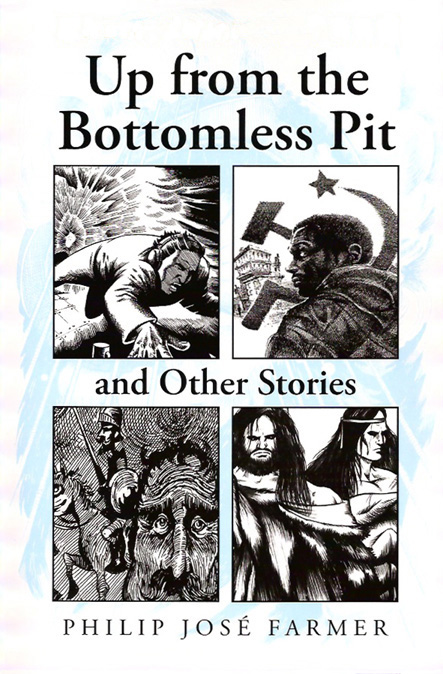
Hayy ibn Yaqzam by Abu ibn Tufayl: An Arabic Mowgli
Phil once again tackles one of his favorite topics; humans raised by animals. Here he puts forth that feral-men stories have been with us since the dawn of man. Though many of these are based on myths or legends there are literary examples, not supposed to be based on real events, that date back a thousand years. The author of this story, Abu ibn Tufayl, was a Sufi, another topic that Farmer is particularly interested in.
- Journal of the Fantastic in the Arts Vol 3 No. 3, 1994 (First appearance)
- Farmerphile No. 4, April 2006
- UP FROM THE BOTTOMLESS PIT AND OTHER STORIES, Subterranean Press, 2007 hardcover

Robert Bloch: An Appreciation
Phil wrote one of many remembrances of his long time close friend Robert Bloch. There is also and interesting long career restrospective.
- Locus #406, November 1994 (First appearance)

Dede Weil: An Appreciation
One of many remembrances of Dede Weil, wife of Gary K. Wolfe and a close personal friend of the Farmer's. There is also a picture of Bette Farmer with Dede Weil.
- Locus #479, December 2000 (First appearance)

I Still Live!
This speech was Phil's keynote address to the "Normal Beans" at the 75th anniversary dinner of the publication of TARZAN OF THE APES.
- Farmerphile No. 3, January 2006 (First appearance)
- UP FROM THE BOTTOMLESS PIT AND OTHER STORIES, Subterranean Press, 2007 hardcover

Why Do I Write?
Phil was the Guest of Honor at the 1992 Conference for the Fantastic in the Arts where he delivered this speech. The original version of it appeared in a French magazine which asked that question of 400 authors.
- Farmerphile No. 4, April 2006 (First appearance)
- UP FROM THE BOTTOMLESS PIT AND OTHER STORIES, Subterranean Press, 2007 hardcover
- THE PHILIP JOSÉ FARMER CENTENNIAL COLLECTION, Meteor House, 2018 Deluxe Limited Edition hardcover, hardcover, trade paperback
Entry
Several quotes by Phil talking about his life.
- MY PRYOR YEAR, iUniverse, 2006 (First appearance)

A Modest Proposal
A letter to the editor of the local newspaper, from Phil, but signed "Kilgore Trout," where he suggests the city convert the abandoned Pabst brewery to a brothel. He then elaborates on the economic benefits of his plan.
- Farmerphile No. 10, October 2007 (First appearance)

Sherlock Holmes & Sufism
This is a speech Phil gave to a chapter of the Baker Street Irregulars (most probably the El Paso, Texas, based Mexborough Lodgers) in 1975. In it he speculates on Holmes' adventures during "the great hiatus."
- Farmerphile No. 12, April 2008 (First appearance)
- THE PHILIP JOSÉ FARMER CENTENNIAL COLLECTION, Meteor House, 2018 Deluxe Limited Edition hardcover, hardcover, trade paperback

Three Metafictional Proposals
This article contains three detailed proposals for books Phil wanted to write. One on the lives of great fictional detectives, one on fictional heroes and villians and their real life counterparts and the third based on the memoirs of Sir William Clayton, "a very adventurous and horny Englishman who lived from 1799 to 1902."
- Farmerphile No. 12, April 2008 (First appearance)
The Wild Weird Clime
Phil gave this speech as the Guest of Honor at Balticon II in 1977. He discussed his plan to write a novel about life in the science fiction world.
- Farmerphile No. 13, July 2008 (First appearance)
- THE WORLDS OF PHILIP JOSÉ FARMER 3: Portraits of a Trickster, Meteor House, 2012 trade paperback

Doc Wildman's Coat of Arms
In the 1970s, after designing Lord Greystoke's coat of arms, Phil began one for Doc Wildman but never completed it. After months of studying Phil's notes, Win Scott Eckert conveyed the design to artist Keith Howell who produced a stunning finished product.
- Farmerphile No. 14, October 2008 (First appearance)

Buddha Contemplates His Novel
This speech was given sometime in the second half of 1981. Phil begins by saying that science fiction takes in all fields of human thought and activity, but then he ends up with a theory proving that God is not omnipotent.
- Farmerphile No. 15, January 2009 (First appearance)
- THE PHILIP JOSÉ FARMER CENTENNIAL COLLECTION, Meteor House, 2018 Deluxe Limited Edition hardcover, hardcover, trade paperback

Myadzian Journal
Four handwritten pages of notes (along with a typed transcription) from the late 1930s where Phil first describes the character Kickaha, who happens to be an "Amerindleocentaur," and a World of Tiers called Myadz.
- Farmerphile No. 15, January 2009 (First appearance)
A Writer's Prayer
A long prayer that asks not for the impossible, just the necessary, please no more computer glitches!
- THE WORLDS OF PHILIP JOSÉ FARMER 1: Protean Dimensions, Meteor House, 2010 trade paperback (First appearance)
A Slender Tribute to a Big Man
This tribute to Robert Bloch was found in Farmer's files. It may have been written for a convention program, but to date this has not been verified.
- THE WORLDS OF PHILIP JOSÉ FARMER 2: Of Dust and Soul, Meteor House, 2010 trade paperback (First appearance)